Search This Blog

Showing posts with label milk. Show all posts

Sunday, April 26, 2015

Milk test

Today is the first milk test.  I'm sure I'm complicating everything far more than necessary (why make it easy, when with just a little effort you can make it really difficult?), but this morning I had all kinds of containers out there in the milking froom:  a strip cup to get the first and last of the milking so I don't miss anything, the container for the milking machine, a pail for pouring all of that into so I can weigh and sample the milk after each doe, a pail to pour all the milk together after sampling, and finally a pail of warm water to wash everything out between does.  Good grief!  Nothing straightforward about it.  I think I need to find out how others do it so I can streamline this a bit.

Cassie, bless her little heart, milked over 8-1/2 lbs and she's just three weeks fresh.  She may not have a "pretty" udder, but she fills the pail. The next in weight was Dandelion, which isn't surprising since her dam, Beatrice, was producing 13 lbs of milk when she was 4 years old.   The next two in order were Dolly and then D'Arcy, neither of which milked as much today, test day, as they did yesterday. 

I find myself wondering if not having their kids will affect their milk production.  Certainly the kids are all screaming their heads off.  They don't like not being with their Mamas.  I'm beginning to see why a lot of people don't dam raise and milk test, too.  They certainly have good appetites.  All 8 kids were fed within 20 minutes, and I have no doubt the next two feedings will be as speedy.  I've learned to let them out two at a time to feed, then shuffle them into another area before I bring out the next two.  At three weeks old, these critters are a force to be reckoned with.

Friday, April 29, 2011

On milk, homeopathy, and herbs

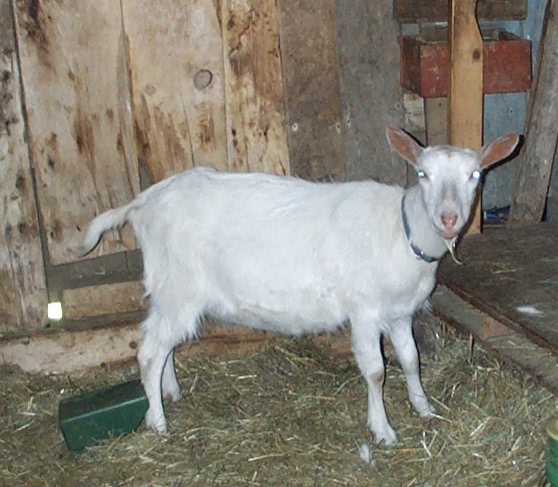
Sanuba, bless her pea-pickin' little heart, is up to a quart a day of milk--and what wonderful milk it is! Sanuba, as her name implies, is Saanen/Nubian cross.  My other milker is a full Saanen, and though Bea gives delicious milk, it's low in fat. Sanuba's milk, on the other hand, is rich and full of butterfat.  I can actually skim it right off the top the next morning. Yum!

Buckling, Sanuba and Emily
Sanuba's doeing is already gone, sold at a week old, and her buckling is happily playing outside with the others, dodging horses' feet, investigating geese, and generally taking life as it comes. 


I'm milking Snub (Sanuba) three times a day, not because she has such a huge quantity of milk, but because we're still battling congested udder. I've been working with Glen Dupree, a homeopathic vet in Louisiana, to resolve this, and we're definitely making progress.  From one teaspoon of milk, painfully (for me) extracted, she has increased steadily to a little more than a quart today.  Her buckling is getting all he wants, as well, and I'm sure he's consuming at least a quart or more a day.  This has been a long road for both of us.  I've been massaging her udder at every milking, applying hot and cold packs twice a day, giving her herbs, Ester C, and homeopathic remedies as directed, and though she's much softer and more pliable than before, we still have a way to go.

Today I got some udder salve and herbs from Fir Meadow to add to the protocol. I like Kat Drohval's products, and my goats eat them readily.  Her BWW Wormer is great. In combination with GISoother, it's kept my goats from being plagued by parasites.  The GI Soother targets Haemonchus contortus, a particularly nasty worm that Beatrice contracted from the sheep that was here when she got here.

Emily
Emily has already started to bag up a bit.  I thought her due date was May 30, but I'm thinking perhaps she actually had a false heat?  No wonder my goats keep me crazy!  They won't even let me know when the buck is no longer of interest!  At any rate, after Snub's surprise pregnancy, I'm going to be prepared for both a May 9 due date and a May 30th.  I hope she has bucklings so I don't have to pull the kids. CAE positive does do take some management, no doubt about it.

Leah
Leah is also bagging up, but the earliest date for her would be May 29th. Let's see now--I bred her because I wasn't sure anyone else had been bred, is that right?  From now on, I will not assume that no one's been bred, even if they're tail wagging to beat the band, batting their eyelashes seductively at the buck, and blatting their heads off--or even if they're just plain not interested when they see the buck.  Perhaps, after all, they just want a little privacy.  What a learning experience this has been!


Friday, January 14, 2011

Henry Milker: First Impressions

I got my new Henry Milker a few days ago.  I've used it several times now, so here are my first impressions.

It's a lot slower than hand milking. Even with hands that hurt while I milk, I can still milk out my doe in 4-5 minutes.  The Henry Milker takes 8-12 minutes, mainly because I can only milk one side at a time.  On a few occasions, I've used the milker on one side while hand milking the other.   That still gives my hands a rest.

That's actually the biggest downside to this milker.  There's plenty to like.  For one thing, I was pleasantly surprised to see that it gets out most of the milk, so that when I hand strip, I'm looking at 1/4 to 1/2 cup in total.  That's a big improvement over the Maggidan's milker I tried last year, and the self-built unit I tried before that.  With both of those, I had to hand milk a good half and more, since the milkers consistently left that much in the goat's udder.  To be fair, Maggidan's advertises their milker for mini's, and maybe it works great for them. It doesn't work well on a full sized goat like a Saanen.

The Henry Milker has a great pump, and I love the gauge that lets you know exactly how much vacuum pressure is on the teat.  I've been using between 5 and 7 pounds of pressure, and that puts a steady stream into the jar.  Two quart jars are provided.  One was broken on arrival, but my one doe in milk, Beatrice, produces around 6 cups per milking at the moment, and that will increase with lengthening days, so I use a half-gallon Mason jar.

The first few milkings, I put the milk through a filter anyway, just to see if it was really as clean as advertised.  It is, but I still use a filter for the strippings. That's hardly a problem, though, since we're only talking a small amount.

What I'd love to see is a Y for the tubing so I can attach a tube and teat cup to each teat and finish the milking in half the time--or the approximate time it takes me to hand milk.  I'm not sure that would work, but I may experiment.

The tubing is very easy to clean; the tiny brushes provided cut way back on the possibility of tiny bits of milk calcifying in the tubing.  The only difficulty I've had is getting the tubing off the pump--it just doesn't want to let go!  Cleanup is fast and easy, a real plus.

I'll continue using the Henry Milker over the next 2 weeks of my trial period.  If nothing untoward occurs with it, I'll most likely keep it.  Even if it's slower, it sure does give my hands a rest.  That in itself makes the Henry Milker worth every penny of its purchase price..

Oh, and did I mention that Mike Henry is very quick about answering questions and lending support by email?


Friday, January 22, 2010

A Victory for Raw Milk

U.S. Dept of Agriculture, the FDA, and various state governments have been waging a war against raw milk for years.  Swat teams hold women and children at gunpoint wihle they haul away "evidence" and "contraband" (raw milk, computer records, dairy equipment) and consumers are treated like children who can't make decisions for themselves.   This, of course, is all under the auspices of "protecting" us against our own stupid decisions.  Like other socialist policies, this looks well-meaning on the surface, but the loser is always the private citizen, and the winner is always corporatism and agribusiness.

A recent ruling in a Canadian court is a ray of sunshine in an increasingly bleak landscape.  Michael Schmidt, an Ontario farmer, was acquited of 19 charges brought against him by the Ontario Ministry of Health.  Schmidt had been running a cow share program to provide raw milk to those who would prefer their milk and cheese unpasteurized.  You know, the way it's been consumed for millenia.

In today's world, common sense takes a back seat to hysteria and corporate interests, and the uninformed eagerly nod their heads in acquiescence, thankful for Big Brother's solicitude.  Others, like myself, see what is happening to our food supply, investigate claims made by public health officials, and compare that to historical data.  I, for instance, concluded that raw milk, raw honey, and other raw foods can't be the threat we're told or the human race would have died out long ago.  Obviously that didn't happen, despite the lack of officialdom looking over our shoulders and monitoring our every mouthful until the recent past.

If every judge were as thorough as Ontario Judge Paul Kowarsky, it would be a better, safer world.  Those who want to drink pasteurized milk would be free to do so, and those who like raw, would be safe from gestapo tactics.

Food protection advocates energy would be better spent protecting us from genetically modified foods, contamination of open-pollinated crops, and providing labeling laws that allow us to know just where the threats in our food actually lay.  Instead, they harass small farmers and private food coops, discourage the buy and eat local movement, and work to convince the European Union that GM products don't really need to be labeled, using the long arm of the U.S. government to further the interests of Monsanto et.al.

As for me, I plan to continue drinking my own raw milk and making my own raw cheeses.  I have my very own raw milk machine, and she's a lot friendlier than agribusiness.