Search This Blog

Showing posts with label health alternatives. Show all posts

Friday, January 30, 2015

A clean herd

I just received test results from WADDL (Washington Animal Diagnostic Lab).  All my herd are negative for  CL and Johnes, and those tested for CAE are also negative.. Beatrice and Leah have been CAE positive for years, but asymptomatic, so I didn't bother having them tested.

Since I run my herd together, l give everyone CAE nosodes--homeopathic immunization--which I buy from Ainsworth's, a homeopathic pharmacy in England, because they carry a higher potency than what is available in the U.S.  That makes for a more effective immunization program. 

Dr. Isaac Golden, an Australian homeopath, did his doctoral work on the efficacy of homeopathic immunization vs vaccination.  In all cases, homeopathy is just as effective as vaccination; in some cases, it's even more effective.  In the case of CAE, there are NO vaccines, but homeopathy can still protect my herd.  For those wanting more information, his website has a free course for parents.  Though Dr. Golden doesn't treat animals, the principles are the same as for humans.  I do love homeopathy!

I also use homeopathic nosodes to protect my dogs from kennel cough and other diseases, and have used nosodes to protect my horses from Rhinoneumonitis and West Nile Virus.  This is an alternative that I'm grateful for, that is proven, and that, unfortunately, conventional medicine has a field day bashing, because they don't understand how it works.  Frankly, I don't care how homeopathy works.  I'm just glad it does.

Monday, January 20, 2014

Treating burns with heat

A couple of days ago, I was taking hot pans out of the oven.  In a rush, and not paying attention, I started to pick up a hot baking dish, but quickly let it go--too late.  My fingers burned!  Remembering an article I'd read a while ago about using hot water instead of cold to treat burns, I immediately ran hot water, as hot as I could stand, over my fingers and hand.  Then I rested my hand in a bowl of hot water--again, as hot as I could stand--for about 15 minutes.  When I got through, the results were nothing short of miraculous.  My fingers had a mild sting, barely noticeable, with no blistering whatsoever. 

The next day, there was no sign of having been burned at all, not by sight nor by sensation.  The baking dish had come out of a 400°F oven only 5 minutes before, it had not cooled, my fingers grasped it firmly before I let go.  I've grabbed hot things before--who hasn't?--and have always had at least mild blisters, or at least reddened skin, but not this time.  

It makes sense, when you think of it.  We treat frostbite with cool water, slowly raising the temperature of the skin, then why not decrease the temperature slowly as well, so as to avoid tissue damage?  Treating burns with heat is very homeopathic, to say the least.

Now, I don't know if I'd use hot water on a burn from liquids.  I'll have to think about that.  However, for dry burns, I'm keeping this one in my repertory.

Oh, and as an aside, I searched for this treatment on the internet.  Maybe it can be found on page 1004, but no matter how I phrased the search, I was unable to find any reference to treating burns with heat.  So much for information availability. I don't remember when or where I read about it, but I can't find it now. 

Tuesday, March 5, 2013

Homegrown: or A Tale of Two Chickens

Since it's so hard to find healthy food in the supermarket nowadays, what with genetically engineered and heavily sprayed foods presenting themselves everywhere, without even a warning label, I've been growing more and more of my own food, or buying local organic.  Now, I have no problem with sprayed, genetically engineered foods being sold.  If someone wants to buy them, it's not my place to tell them otherwise.  On the other hand, I come down firmly on the side of "right to know".  I have a real problem with someone, anyone, withholding that information from me.  It's MY body, it' MY choice, regardless of the DOJ (Department of Justice) arguing that I don't have a right to choose my own foods.  How any self-respecting lawyer could argue that in court is beyond my ken.  Perhaps they're not self-respecting.  Perhaps the job is more important than integrity.

It will come as no surprise, then, that I raised my own chickens last years.  Five of them, young cockerels, went to freezer camp.  Since I don't eat much meat, most of them have stayed there until lately.  The problem with freezing foods, you see, is the potential for freezer burn.  Canned foods last longer, and I decided to empty the freezer of all the meat and pressure can it.

I went through the freezer, pulling out anything that had been in there for several months. One of the chickens I pulled out was commercially grown chicken, while the others were homegrown.  As I prepared them for canning, I was struck with the difference between the two.  In all the pictures below, the one on the left is homegrown, the one on the right is commercially grown.  The difference is color is astonishing.  My homegrowns ranged far and free, all over the pasture, up into the berry patches, eating grass, weeks, and insects galore, roosting at night in the barn coop with the others.  The one on the right probably never saw the light of day or anything green and living.  The livers, especially, tell the tale.  The homegrown chicken was healthy and both the color and the texture of the liver show it.  It's dark and firm.  The liver of the commercial chicken, on the other hand, was not only lighter in color, but the texture was spongy and it easily fell apart.

Belly up.  The skin on the left is yellow, that on the right is gray.

Belly down.  Same story.


The livers.  That on the left is much healthier looking than the one on the right..

If ever I had wondered if it was worth it, I wonder no more.

Friday, December 21, 2012

No-poo, Oh pooh.

I decided to try the "no-poo" routine about, oh, maybe 2 months ago.  No more commercial shampoo, no more commercial conditioners.  So, at a friend's suggestion, I searched the internet and found a routine I could experiment with:

1 Tbsp baking soda in a cup of water to shampoo
1 Tbsp apple cider vinegar (ACV) in a cup of water to condition

And so it began.  I dissolved the baking soda in a cup or so of warm water and slowly poured it over my scalp, massaging gently,  The rest of the hair got wet as a matter of course, but I massaged it through anyway; then a good rinse and on to conditioning.  The same  routine applied to the ACV: massage into the scalp, make sure the hair is wet down with the solution, and then a thorough rinse.

The results surprised me.  A comb went through my hair easily, and it felt, looked, and smelt clean and fresh.  Not bad.  I continued with this routine every 5-6 days until last week, when my hair started looked just a tad dryer than I wanted it. 

My friend had told me she used a raw egg yolk to condition occasionally, and I, ever willing to complicate everything, went looking for a "recipe" to do what should have been a simple task.  Why keep things simple when with a little effort I can make them really complicated?  Accordingly, I found a recipe to mix 1 tbsp olive oil and a tablespoon of water into the well-beaten yolk and leave it on for 5 minutes, before I rinsed thoroughly with lukewarm water.

What a disaster!  I felt like I had rolled my hair in an oil barrel, even before I got out of the shower.  I shampooed with Dr. Bronner's Peppermint Castile Soap, rinsed thoroughly and used ACV solution to condition, all to no avail.  The comb pulled and tugged. The hair looked like I hadn't washed it in weeks, so greasy that it hung in clumps.  I deceived myself (I'm good at that.  Lots of practice.)  I told myself my hair was just wet, that all would come right when it dried. 

It didn't.  I tied it back and combed and brushed it daily before tying it back again every morning.  Today, after trying unsuccessfuly to rid my hair of the olive oil with the baking soda/ACV routine, I broke down and shampooed it with a commercial shampoo.  I then followed it with ACV solution again.

My hair is back to normal now.  I will never put olive oil in my hair again, no matter what great success others have had with it.  I'll try the egg yolk conditioner again, though, only this time it will be just egg yolk, beaten within an inch of its life so it behaves well on my hair.

Monday, October 1, 2012

Juicing

After watching Forks Over Knives and Fat, Sick, and Nearly Dead, I got inspired.  I've never felt so good as when I was eating mostly raw foods, and somehow I've gotten away from that in the past year or two.  So, I borrowed my friend Doreen's Samson Juicer, and did a 10 day juice fast.  I dropped 6 pounds in 10 days, but that was a side benefit.  The real purpose was to detoxify my body and reset my eating habits.  A week after the fast ended,  I was still juicing daily--and sometimes more often than that--and I felt better, though still rather low on energy.

A couple of weeks later, toward the end of July, my new Jay Kordich Powergrind Pro Juicer arrived, and I returned the Samson.  The PGP Juicer is quite a different animal from the Samson.  The juice is clearer and sweeter, and I get more from the vegetables that I juice, but the Samson is clearly superior when it comes to juicing greens.  The Samson is also easier to put the vegetables through, but there's added time spent cutting everything up into much smaller pieces.

Powergrind Pro Juicer
Each juicer has its pros and cons, and the PGP is no different.  It defiitely took a while to adapt to it. It took a week or so for me to figure out how best to feed the hopper so nothing jammed.  Since the PGP centrifuge rotates at only a fraction of what other brands do, it's a bit fussier..  On the other hand, because it rotates more slowly, and grinds,too, there is little heat generation, preserving the nutrients from the vegetables.

So far, I've made juice at least 5 days out of 7, and don't really think much about what combinations to use, since they all turn out delicious.  Today I made a cucumber, carrot, and apple juice.  Tomorrow I need to use up some of the celery and greens in my garden.  Maybe I'll throw a tomato or two in there just for good measure.  Or a piece of lemon--that goes very well with greens.

Buying a juicer and juicing daily is probably one of the best decisions I've made for my health.  It's easy to do, fills me up, and my energy is way up there.  Most days I have a blender drink (smoothie) for breakfast, juice throughout the day, and one regular meal.  Since I seem to be on the go most of the time, it's nice to know i'm still getting good nutrition into my body, even though I'm not sitting down for regular meals.

Sunday, February 5, 2012

Full Circle, or A trip around the block.

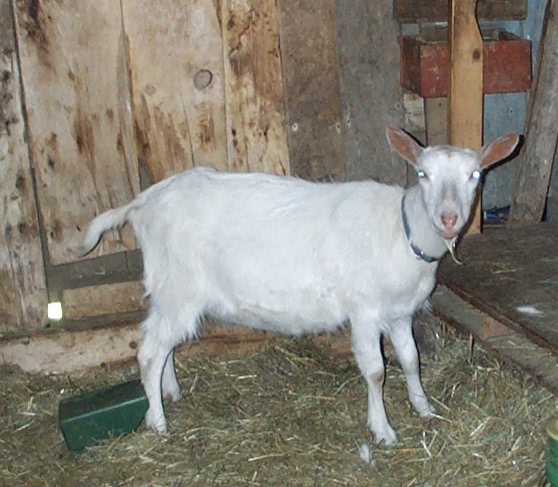
Ever get the idea that you're just not supposed to do something? Yeh, me, too, and it must be that these two goats are supposed to be here, at least for now.

A few days after I sold them, I got a phone call asking if I'd take them back.  These two does are CAE positive, but pretty healthy for all that, and I sold them with full disclosure. The buyer was okay with it at first, but was scheduled to have surgery just about the time Leah was due to kid.  Too much in too short a time, and second thoughts about the CAE.

So, they're back, and I'm in milk again.  Hooray!  I might not let Sanuba go again.  I had second and third thoughts about it, and though she will never give me any registerable kids, I could breed her to a Boer and have meat goats.

Violet and Leah
Leah, bless her pea-pickin' little heart, still has an udder that I don't like, but until I find the perfect home for her, she's here to stay, and keeping Violet company.  They were SO glad to see each other!  Once in their stall together, they immediately butted heads, again, and again, and again! Bam!  Bam! BAM!  Then they cuddled up together for the night, and they've been hanging out together even more  than before Leah left.  Goats are so strange. Or maybe, absence makes the heart grow fonder?

Beatrice is CAE+, too, but she's not going anywhere.  Too good of a milker, bloodlines too good to let go of, and a wonderful udder. CAE+?  Fine, I just pull the kids and feed the pasteurized milk.  I started that last year and was surprised to find it wasn't a hassle at all.  Feeding was more of a hassle than pasteurization. 


I'll continue my CAE protocol:  giving CAE nosodes monthly, giving Apis mellifica during labor to deter congestive udder, and making sure they're well mineralized and as stress-free as possible.  So far my does are symptom free.  I plan on them remaining that way, and if no one else wants them, so be it.  As for their kids, they'll be bottle fed heat-treated milk and live in separate quarters until they're weaned or sold. 

The CAE crowd is divided into two camps:  those who think it's a horrible thing and goats should immediately be culled, maybe even euthanized; and those who wonder what all the fuss is about.  I'm convinced that the first camp consists of those who have never had CAE in the herd, and the second is those who have.  One vet called it "an economic disease", because no one wants to buy them.  He wonders why it's blown so out of proportion.  So do I.  There are so many serious diseases to be cautious of, to really want to eradicate, like Johnes, Caseous Lymphadenitis (CL), Brucellosis, and Tuberculosis, that can wipe out a herd, or even be passed on to humans.  CAE, on the other hand, becomes symptomatic in only 10% of goats that test seropositive, and often very mild symptoms at that.  The worst thing it can do to humans is give them immunity to HIV. Hmm.  Come to think of it, that's not such a bad thing.


Friday, April 29, 2011

On milk, homeopathy, and herbs

Sanuba, bless her pea-pickin' little heart, is up to a quart a day of milk--and what wonderful milk it is! Sanuba, as her name implies, is Saanen/Nubian cross.  My other milker is a full Saanen, and though Bea gives delicious milk, it's low in fat. Sanuba's milk, on the other hand, is rich and full of butterfat.  I can actually skim it right off the top the next morning. Yum!

Buckling, Sanuba and Emily
Sanuba's doeing is already gone, sold at a week old, and her buckling is happily playing outside with the others, dodging horses' feet, investigating geese, and generally taking life as it comes. 


I'm milking Snub (Sanuba) three times a day, not because she has such a huge quantity of milk, but because we're still battling congested udder. I've been working with Glen Dupree, a homeopathic vet in Louisiana, to resolve this, and we're definitely making progress.  From one teaspoon of milk, painfully (for me) extracted, she has increased steadily to a little more than a quart today.  Her buckling is getting all he wants, as well, and I'm sure he's consuming at least a quart or more a day.  This has been a long road for both of us.  I've been massaging her udder at every milking, applying hot and cold packs twice a day, giving her herbs, Ester C, and homeopathic remedies as directed, and though she's much softer and more pliable than before, we still have a way to go.

Today I got some udder salve and herbs from Fir Meadow to add to the protocol. I like Kat Drohval's products, and my goats eat them readily.  Her BWW Wormer is great. In combination with GISoother, it's kept my goats from being plagued by parasites.  The GI Soother targets Haemonchus contortus, a particularly nasty worm that Beatrice contracted from the sheep that was here when she got here.

Emily
Emily has already started to bag up a bit.  I thought her due date was May 30, but I'm thinking perhaps she actually had a false heat?  No wonder my goats keep me crazy!  They won't even let me know when the buck is no longer of interest!  At any rate, after Snub's surprise pregnancy, I'm going to be prepared for both a May 9 due date and a May 30th.  I hope she has bucklings so I don't have to pull the kids. CAE positive does do take some management, no doubt about it.

Leah
Leah is also bagging up, but the earliest date for her would be May 29th. Let's see now--I bred her because I wasn't sure anyone else had been bred, is that right?  From now on, I will not assume that no one's been bred, even if they're tail wagging to beat the band, batting their eyelashes seductively at the buck, and blatting their heads off--or even if they're just plain not interested when they see the buck.  Perhaps, after all, they just want a little privacy.  What a learning experience this has been!


Saturday, April 23, 2011

Surprise kids

Here I've been wondering why my Saanen/Nubian doe (aptly named Sanuba) has such silent heats and why I could never catch her in heat, and it turns out she's the only one that actually caught when the Saanen buck came to visit last November.  I was totally unprepared, had not been feeding this doe as if she were pregnant, had never seen her responsive to the buck at all, so it was a shock when I went out to the barn last Sunday (April 17th), looked in the communal stall, and saw two little kids wobbling around, the doe still cleaning them off, a black and white buckling and an all-white, Saanen-looking doeling..

Unfortunately, all was not well.  I suspect one of them was malpresented, because my poor doe was very reluctant to stand.  She'd struggle to her feet, stay up for a minute or two at most, and down she'd go again.  This is not normal.  I wanted to pull the kids, because the doe is CAE positive, but I was frantically trying to track down some colostrum to feed them.  Thank goodness for good friends and neighbors!  KelLee, my neighbor down the road, quickly came over to help me get the doe up, check her over, and see what we could do to give Sanuba some incentive to stand on her own.  She was definitely acting sore.  KelLee had some colostrum at home, so I followed her there to get it, and when I returned, the placenta had passed and the doe had eaten almost all of it.  KelLee and my son Shawn had taught the doeling to nurse while the doe was lying down, but the buckling was very hungry.

Ironic, isn't it, that the doeling, who I'd most have liked NOT to nurse, was the one who latched on quickly?  Ah, well.  The buckling quickly took to the bottle, and the doeling absolutely refused to have anything to do with it.  Shawn helped me get the doe up and hold her up for 4-5 minutes so the kids could nurse more easily.  After 5 hours, I realized I hadn't seen her drink, so I offered her some water.  You could almost see the lightbulbs go on!  Water!  Omigosh, I'm thirsty.  She struggled up and walked gingerly to the water bucket and drank deeply.  I dragged over a bale of good second-crop hay, and she munched as she lay with her kids. I gave doe and kids a dose of Arnica shortly after the birthing, and later gave Sanuba a dose of Bryonia, as it seemed to match her symptoms well--thirstless, reluctance to move.

Throught the night I fed the buckling and checked the doe.  By morning, it was clear that she was not improving.  I'd already talked to my local vet, so I called her again and confirmed that she was needed. A shot of Banamine and a shot of a long-acting antibiotic, a look at 3 other critters on the farm, and I was poorer by some $200+ but easier in my mind. 

Next day, Sanuba was up and moving around, but had congested udder.  That is, edema of the udder.  The udder was cool to the touch, not red, but hard to the touch, and very little milk.  At that point, I emailed Glen Dupree, a homeopathic vet I think very highly of, having taken a class from him at MOFGA.  He gave me instructions on what remedies to give and when, and advised me to alternate hot and cold compresses twice a day.  Ugh.  I don't know which finds it more disagreeable, the doe or I, but we're both carrying on.

Today her udder is noticeably softer, and instead of getting barely a squirt and working at getting a teaspoonful, I actually got 1/4 cup of milk tonight. :)  Hooray!  Any milk I get is fed back to the doe, disguised as a coating for grain. She's not like Beatrice, who readily slurps down milk or kefir.

As I looked into her stall tonight and watched the kids bouncing all around, rearing up, bucking, and racing in circles, I know why I love husbandry.  I may have come late to the farm, but it's been in my blood for generations.  My grandfather walked these fields and woods with me when I was a child and instilled a love of the land.  This is the way life is supposed to be.

Thursday, January 21, 2010

Adding enamel to teeth

I just came across an interesting claim that monosodium phosphate will actually thicken the enamel on your teeth and prevent cavities.  If it's true, I want to know!  Quickly!  I have a dentist appointmet next week that could perhaps have been avoided.  In the course of my investigation, I found www.toothsoap.com.  It's hard to tell whether the referred to book is necessary or just a good marketing device.  Actually, there's a reference to toothsoap.com and the book on wiki.answers.com.  Call me jaded, but I had to wonder if the owners of Toothsoap posted the wiki answer.

I'm going to spring for some monosodium phosphate and some toothsoap and report back in a month or two.  Wouldn't it be wonderful if this were a journey to a new land where tooth decay is unknown, rather than a short walk down the primrose path?